
August 19, 2026 · WineCompliance.ai
Navigating Dry Zip Codes: How to Avoid Illegal Wine Shipments
A state can allow direct-to-consumer wine shipping and still have zip codes, towns and counties where delivery is illegal. Here's how to find them before a carrier does.
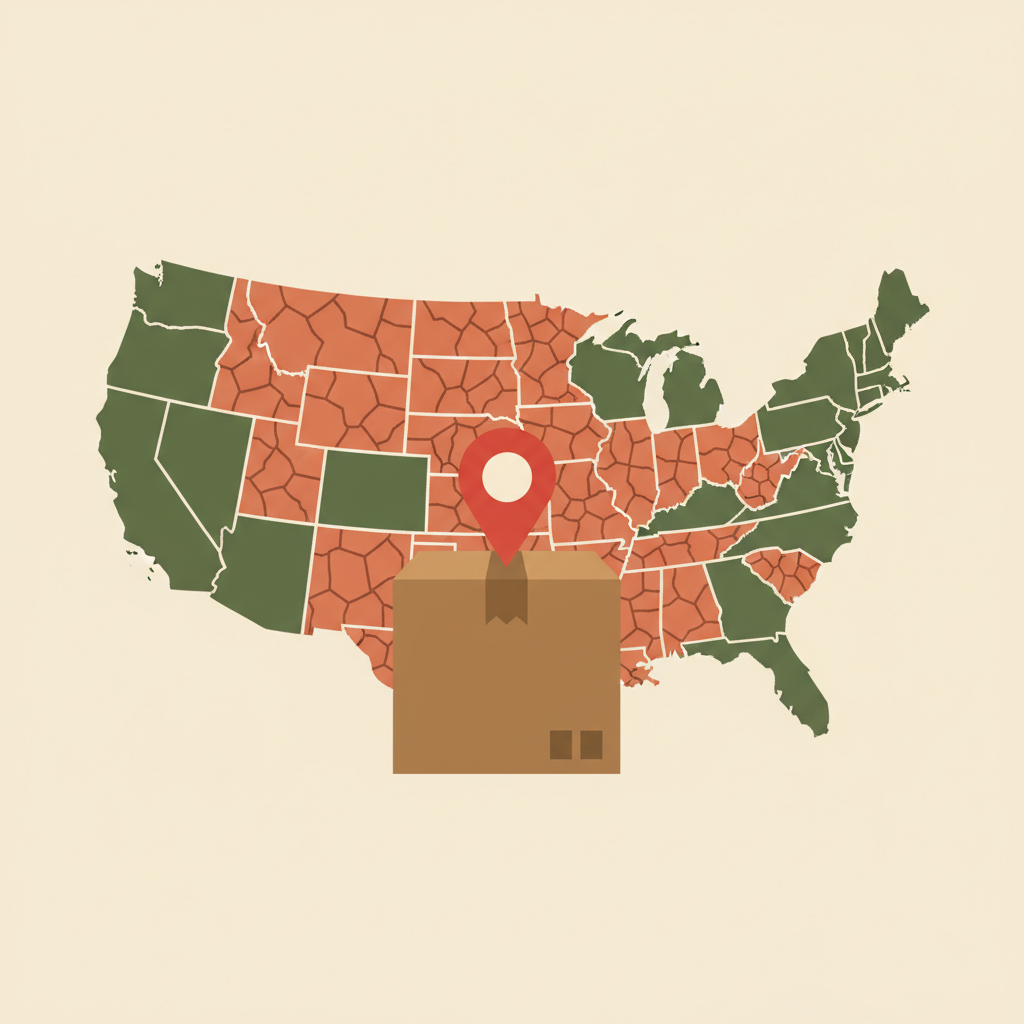
Shipping wine to dry zip codes is one of the most common ways an otherwise compliant winery ends up with a returned shipment, a carrier account flag, or a call from a state regulator. A state can permit direct-to-consumer wine shipping and still contain individual counties, towns or even single zip codes where any alcohol delivery is illegal, and those boundaries rarely line up with the county lines wineries already track for tax and permit purposes.
Key takeaways
- "Dry" means no alcohol sales or delivery at all; "moist" or "wet with restrictions" means alcohol is allowed only under specific local licenses, and both statuses can sit inside a state that otherwise permits DTC wine shipping.
- Dry areas are defined at the city, town or community level in several states, not the county level, so a county-based compliance check can still let an illegal shipment through.
- Carriers hold shippers responsible for destination legality. UPS and FedEx alcohol shipping agreements both put the burden of knowing dry areas on the shipper, not the carrier.
- Consequences range from a returned shipment and restocking cost to carrier account suspension, state fines, or in a few states, liability that historically fell on the winery rather than the customer.
- Address validation and dry zip code databases (through your fulfillment platform or a dedicated compliance tool) catch most of these before a label ever prints, but they need to run at checkout, not just at packing.
What "dry" and "moist" actually mean
A dry jurisdiction bans alcohol sales entirely, so no shipment of any kind, from any carrier, can legally arrive there. A moist or "wet with restrictions" jurisdiction allows alcohol under narrower conditions, sometimes limited to specific license types that a DTC wine shipment doesn't qualify under. Many counties are dry, meaning there can be no alcohol sold at all, and deliveries are prohibited both out of state and in the state. The exception some wineries rely on is a state-issued permit that overrides the local ban, but that permit has to name the destination specifically, and most don't.
Why county lines don't help you here
The instinct is to check a destination against a list of dry counties. That instinct is wrong often enough to matter. In Alaska, restrictions are tracked at the city and community level rather than the county level, and the state has roughly 75 dry communities that prohibit all importation of alcohol, on top of communities where DTC shippers are restricted because last-mile delivery there depends on USPS, which cannot legally carry alcohol at all. Our own rule library reflects the same gap: Alaska's dry and restricted-alcohol list is compiled community by community because there is no official county-level or zip-code-level list published by the state.
Florida is the reverse case, a state where the restriction really is county-level but still easy to miss if you only check the state rule. DTC shipping is prohibited into the three dry counties in Florida: Lafayette, Liberty and Washington, even though Florida otherwise lets wineries ship without a permit. New Hampshire narrows the exception to a single town: direct shipments to dry towns in New Hampshire are prohibited, with Ellsworth being the only dry town remaining in the state. Texas compounds the problem by scale. Texas has 254 counties, and each one can have its own wet-or-dry status, which makes manual address lookups a real risk for missing a violation.
What happens when a shipment slips through
The most common outcome is mundane: the carrier flags the address, holds the package, and it comes back to the winery at the shipper's cost, sometimes with a redirect or restocking fee layered on top. The less common but more serious outcomes are the ones worth planning for. Financial penalties from a state ABC or comparable agency can run to thousands of dollars for a single violation, such as shipping to a dry county or using a carrier that isn't on the state's approved list, and repeated violations can put a winery's direct shipper permit itself at risk.
Kentucky's history shows how far the liability question can swing. Before 2020, state law made it a felony offense to ship wine into any of Kentucky's dry counties, of which the state still has 15, and that risk is a large part of why no common carrier, including FedEx and UPS, would ship into Kentucky at all before the law changed. The 2020 reform, HB 415, changed who bears that risk going forward: the penalty for ordering a shipment into a dry county now rests on the consumer rather than the shipper. That shift did not sit well with everyone in the state's alcohol trade; wholesalers argued the expanded direct shipping undermines a regulated marketplace, while the state's own retail federation pointed out that grocers still can't sell wine and spirits, so the playing field still isn't level. The lesson for shippers outside Kentucky is not to assume any other state has made the same trade. In most states, the shipper still carries the exposure.
Whose job is it to check
Carriers are explicit that this isn't their problem to solve for you. UPS requires an approved list of states in your shipping agreement addendum, and even within an approved state, you cannot ship to dry counties or zip codes where alcohol sales or deliveries are forbidden. UPS's addendum specifically calls out dry-area restrictions in states including Alaska, Connecticut, Florida, New Hampshire, Vermont, and West Virginia, but what UPS does not provide is a checkout-ready method for stores to identify and block those destinations automatically. FedEx frames it the same way in its retailer guidance: areas like the dry towns and counties in Florida are called out explicitly as places FedEx will not deliver alcohol, with responsibility for checking placed on the shipper.
Practical steps that actually catch these before you ship
Use your fulfillment platform's dry zip database. WineDirect maintains a database of dry and undeliverable zip codes, and orders are validated against it to prevent illegal shipments, with any match routed to a queue for resolution rather than shipped automatically. If your platform has this, make sure it's active for every state you ship to, not just the ones you consider risky.
Layer in a compliance engine for the states without clean zip-level data. For states with dry counties or unusual rules, teams often leave the state marked compliant in the storefront and let a tool like ShipCompliant catch the issue after the order is placed, then resolve it by editing or splitting the order before it ships. That's a reasonable fallback, but it only works if someone is actually watching the queue daily.
Push restriction logic into checkout, not just fulfillment. Platforms built for this let you apply destination state or zip-level restrictions per product category, including sub-state restrictions like dry counties, and hide shipping methods entirely when a product can't legally go to that address. Catching the problem before payment is a better customer experience than canceling an order afterward.
Validate the address itself, not just the compliance status. Address verification tools check an entered address against an authoritative source such as the USPS database to confirm the address is real and deliverable, which matters because a mistyped zip code can put an order in the wrong jurisdiction entirely, dry or not.
Be honest about what you can't ship, publicly. Some wineries simply opt out of the hardest states rather than manage the exception list. Dry Creek Vineyard's own shipping page states plainly that it is unable to ship to Alaska, Arkansas, Maine, Mississippi and Utah. That's a defensible choice for a winery without the staff to track community-level restrictions in a state like Alaska.
Where the tooling still falls short
No tool available today gives a small winery a single, always-current, zip-code-level list covering every dry and moist jurisdiction in the country. Alaska's list is compiled community by community because the state itself doesn't publish it at the zip level. UPS's own addendum names the states with dry-area risk but, as shippers who've built checkout logic around it point out, the policy exists while the technical enforcement often does not, leaving a real gap between knowing the rule and stopping the order before it ships. That gap is exactly where manual review breaks down at any real order volume, and it's why the wineries with the fewest returned shipments tend to combine a platform-level dry zip check with a second, independent address validation step rather than trusting either one alone.
Frequently asked questions
Can you ship wine to a dry county?
No. If a county, town or community has a dry status under state or local law, no common carrier can legally deliver alcohol there, and a state-level winery permit does not override a local dry designation unless the state law says so explicitly.
Do UPS and FedEx block dry zip codes automatically at checkout?
Not by default. UPS's addendum names the states where dry-area restrictions apply, but it does not provide a checkout-ready method for stores to identify and block those destinations automatically, so that logic has to be built into your storefront or fulfillment platform.
What's the difference between a dry and a moist zip code?
A dry zip code prohibits alcohol sales and delivery outright. A moist, or "wet with restrictions," zip code allows alcohol only under specific local licenses, which typically don't cover a direct-to-consumer wine shipment even though some alcohol commerce is technically legal there.
What happens if my winery accidentally ships to a dry zip code?
At minimum the carrier holds or returns the shipment at your cost. Depending on the state, you may also face regulatory fines, and repeated incidents can put your direct shipper permit at risk, which is a bigger cost than the returned bottle.
Does county-level checking catch every dry area?
No. Alaska tracks restrictions at the city and community level rather than county level, and several other states carve out individual towns, like New Hampshire's Ellsworth, so a county-only check will miss real restrictions.
Sources
For more on how specific states handle wet and dry areas alongside their DTC permit rules, see our guide to , or check your destination against current rules in our .
This article is general information, not legal advice. Verify current requirements with the state agency or your compliance provider before shipping.
- Compliance
- DTC Shipping
- Dry Counties
- Carrier Rules
- Best Practices
This is general information, not legal advice — verify with your compliance provider before shipping.